
When I was asked to create a piece of jewellery based on the German war concept ”Gold gab ich für Eisen”, it made sense to delve into my own family history. I grew up as part of the German minority in Southern Jutland, where my father's family has been part of Haderslev's upper middle class for generations. My hunch that a relative might have donated gold to support the German war effort was correct: my father told me that his grandmother (my great-grandmother) Helene Henriette Meyer, née Castens, once proudly showed him an iron watch chain that she had had made after donating her own gold watch chain to ”Das Vaterland” during World War I.
 Helene and Peter Meyer ca. 1893
Usually a small medallion with the text ”Gold gab ich zur Wehr, Eisen nahm ich zur Ehr“ was presented on this occasion. But if they could afford it, the donor, like Helene, had a copy of the original gold jewellery made in iron. In this way, they retained the utility function and could demonstrate their patriotism at the same time.

Many Germans and German-minded people donated their jewellery to the German defence, both during the First and Second World Wars. Often for patriotic reasons, no doubt, but for many women who stayed at home to watch their husbands, fathers, sons and brothers go off to war, the primary incentive may have been different: perhaps the extra weapons, food or blankets that the donated gold could buy helped ensure that their loved ones returned home (in one piece)?
Helene had good reason to be concerned, as both her husband, doctor Peter Meyer, and their two eldest sons (who were both medical students) took part in World War I on the German side, although he did not approve of the war any more than the Danes at home in Haderslev. Unfortunately, not everyone survived, as the eldest son Hans Oluf fell in France. So it could be argued that Helene's donated watch chain had at least partially ”worked”.

Peter and his son Otto Meyer at the Russian front in 1917
My work
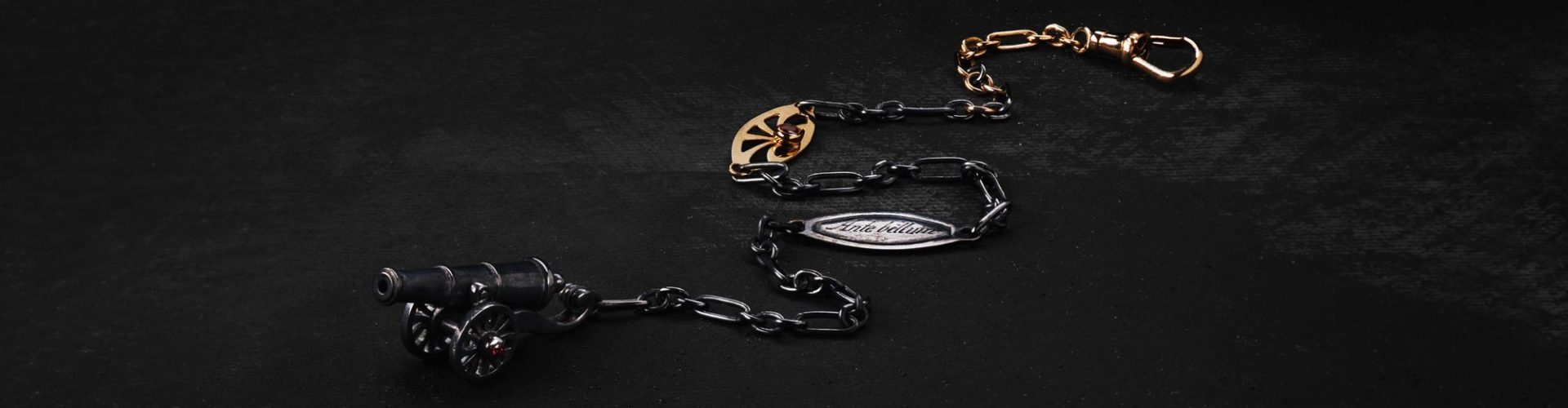
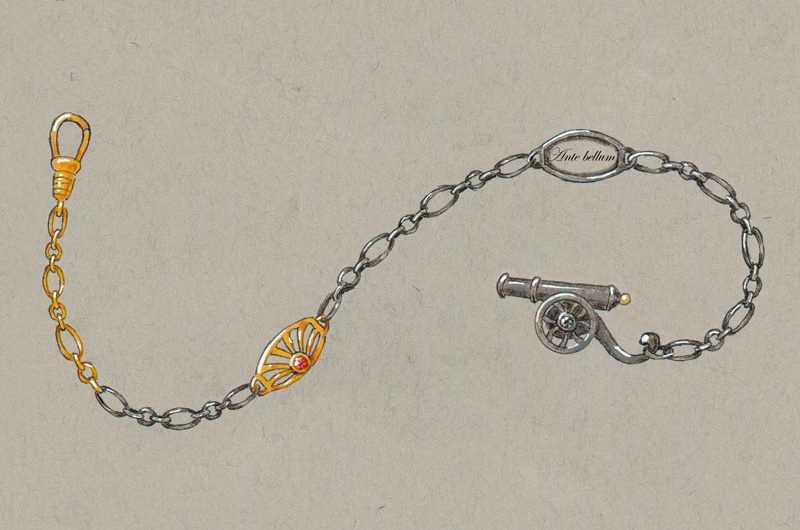
My contribution to the exhibition Macabre Masterpieces is based on a women's watch chain, which is characterised by being slightly spindlier than men's watch chains. On the other hand, they were often adorned with small decorative plaques. To illustrate the transformation from gold to iron, the beginning of the chain - its clasp and the first few centimetres, is made of 14k gold and then goes on to be made of oxidised silver, illustrating the dark iron.
Along the way, two plaques are inserted. The first is gold with a ruby, which can be interpreted in two different ways:
1. a sunrise - classic symbol of the hope donors have by giving their gold to the war effort.
2. An explosion - caused by the weapon at the end of the chain.

The second plaque is silver with the engraving ”Ante Bellum” - ”Before the War” in Latin. The better prepared you are before the war, the greater your chance of survival.

The chain does not end in a watch, but in a silver cannon with rubies set in the hubs of the wheels. Based on what I assume is Helene's donation, the cannon is created in what is often referred to as a ”Victorian style” or, ”Gründerzeit” as the style was called in Germany in the late 1800s.

The cannon is kinetic in that the wheels and barrel are all movable, a nod to some of the eggs Fabergé created around the same time for the Russian royal family, which sometimes contained surprises in the form of miniature means of transport, such as a carriage with movable wheels.

Photo: Miklos Szabo & Ida Buss
In hoc bello (during this war)
These days, war has a different kind of presence. War is something that my generation and my daughter's generation have simply not been used to, other than as ”entertainment” in books and films or as something that happens very, very far away. In light of Russia's attack on Ukraine, I also notice that I have a more nuanced perspective on my work since I created it in spring 2021.
Since the Second World War, the Germans have been good and peaceful neighbours with whom we want to trade, visit and are not ashamed to be related to. The last of those who lived through and remember the war have now left this world. Today, on the other hand, we live together without any problems, not least because Germany has actively decided to put aside its imperialist inclinations once and for all (Putin could learn something here). The harmonious coexistence is certainly also due to the fact that the border between our countries was drawn as a result of a referendum after the First World War. Schleswig was divided into North and South Schleswig, and this border demarcation and subsequent peaceful coexistence is actually relatively unique in the world, which is why committees and government representatives from many countries with border challenges have been on a study tour with us.

Unfortunately, that is not the case in Ukraine. When you find yourself in a war, regardless of whether it is your own or another country's government that has taken the initiative, I imagine that most people will be against war - war in general - for so many obvious reasons that it makes no sense to list them. But if war is a fact of life, it makes sense for the population to try to support ”their boys” and survive the crisis as best they can, even if it means fleeing. For most people, including my family, it was about their own beloved family members and the fear of whether they would ever return from the battlefield. I think Ukrainian wives making Molotov cocktails as well as Russian mothers of recruits sent on ”exercises” at the Ukrainian border can both relate to that reaction. They just want it to stop and for their loved ones to come home in one piece.
In that light, I understand my great-grandmother's donation extremely well and I would imagine that I would probably have acted accordingly. My thoughts these days are with the Ukrainian people, as well as with the millions of Russians who in no way approve of the war that their government has so unprovokedly launched against their ”brother people”.

Materials used
5g 14k gold
20g 925 sterling silver - oxidised
Total 0.2ct rubies
(3D work is done/sponsored by my little brother, Poul Meyer)
See my watch chain and many other exciting, beautiful and provocative death jewellery at Sønderborg Castle in the exhibition Macabre Masterpieces, curated by Nina Hald. The exhibition is on display from 8 April to 23 October 2022.
Blog categories