

Here is Georg Jensen's own description of what they wanted:
Your design proposal should be able to function as both a pendant and a brooch. In addition, it must contain elements that honour Her Majesty the Queen, the government anniversary or both. The design must be in silver. The design can include a gold element, for example by being gold-plated or having a gold inlay. The design can also include a coloured element such as a stone or enamel.
All launched with a beautiful video on the website:
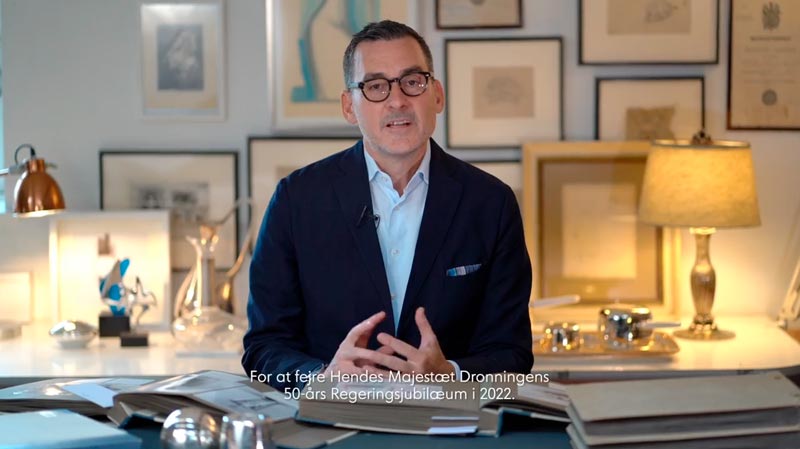
(Link may cease to function once the competition has ended)
I wasn't going to let that pass me by and immediately had a number of thoughts:
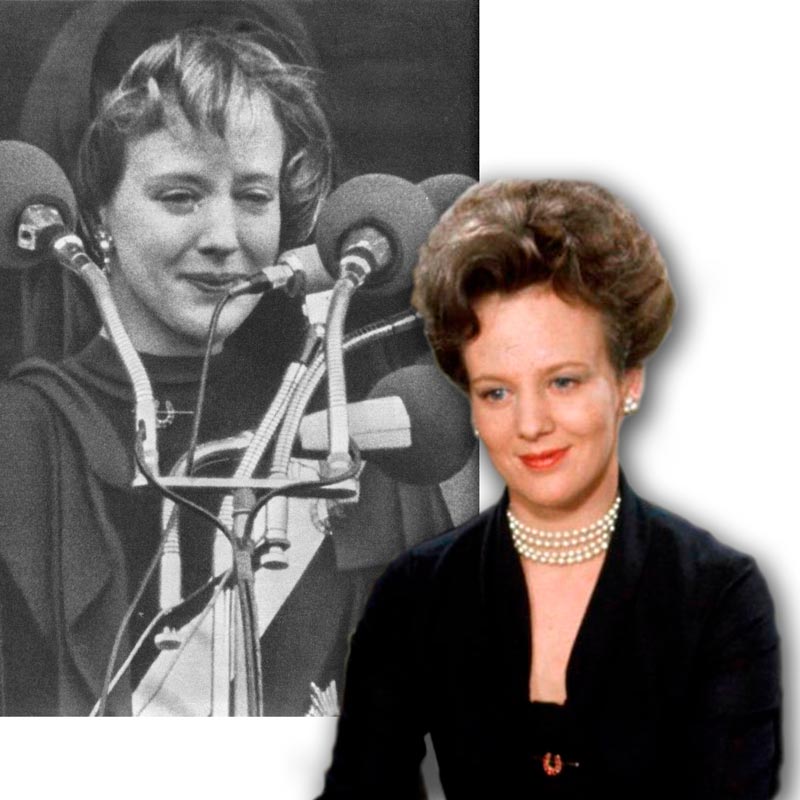
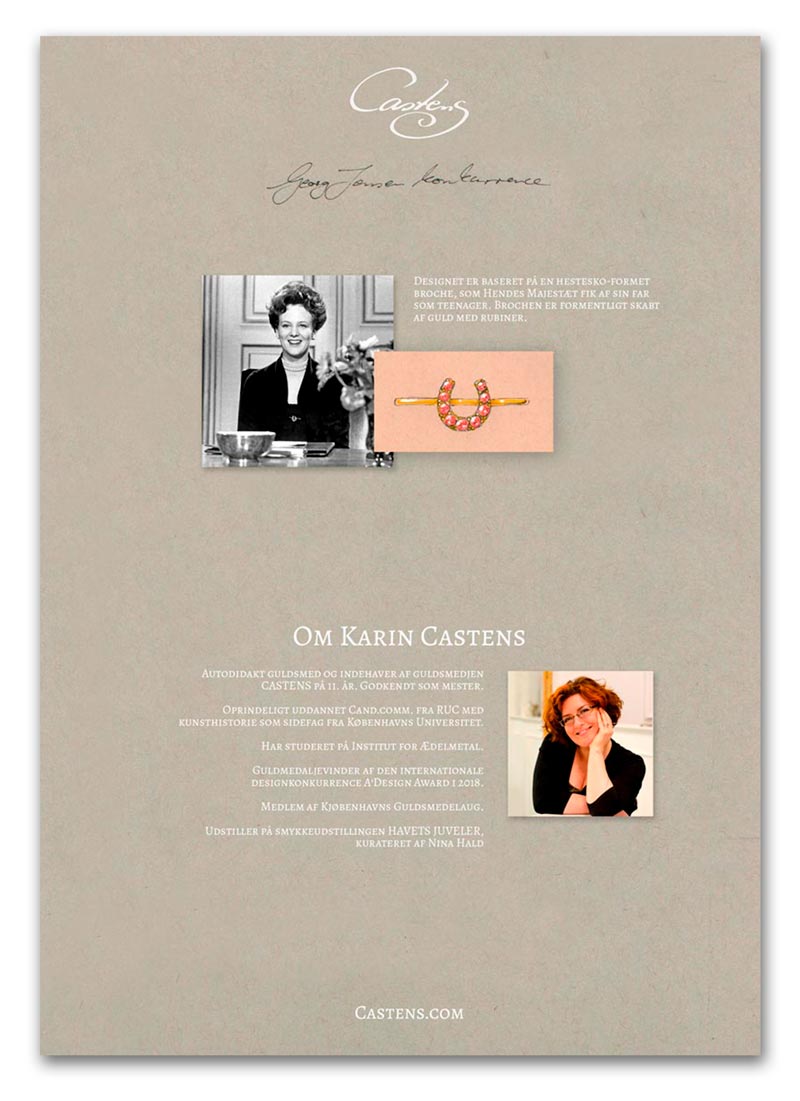
My jewellery was to be based on a brooch given to the Queen as a young girl by her father, King Frederik IX. It has the shape of a horseshoe set with rubies and is placed on a horizontal stick (or maybe a riding crop?). There are no pictures of the jewellery up close, so we have to guess from the relatively few pictures of His Majesty wearing the brooch. For good reason, this brooch has great sentimental value, and the Queen wore it the day her father died and she was proclaimed Queen of the Danes and has since been seen wearing it regularly.
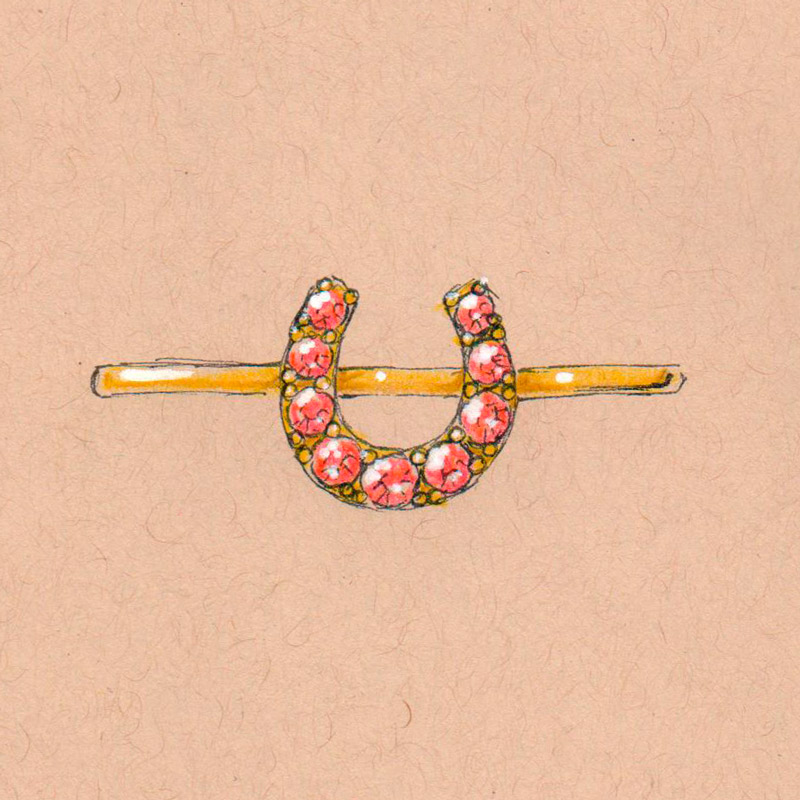
There were no close-up images of the brooch until January 2022, but I guessed it must look something like this:
In the meantime, to mark this year's Amalienborg exhibition “A queen's jewellery box” with the Queen's private jewellery, I actually got a really good close-up of the brooch, which turned out to have a few more details than I originally thought. Including some tiny antique-cut diamonds, which may well have come from another piece of royal jewellery that was reused on another occasion and had some diamonds left over:

Photo: Jens Peter Engedal
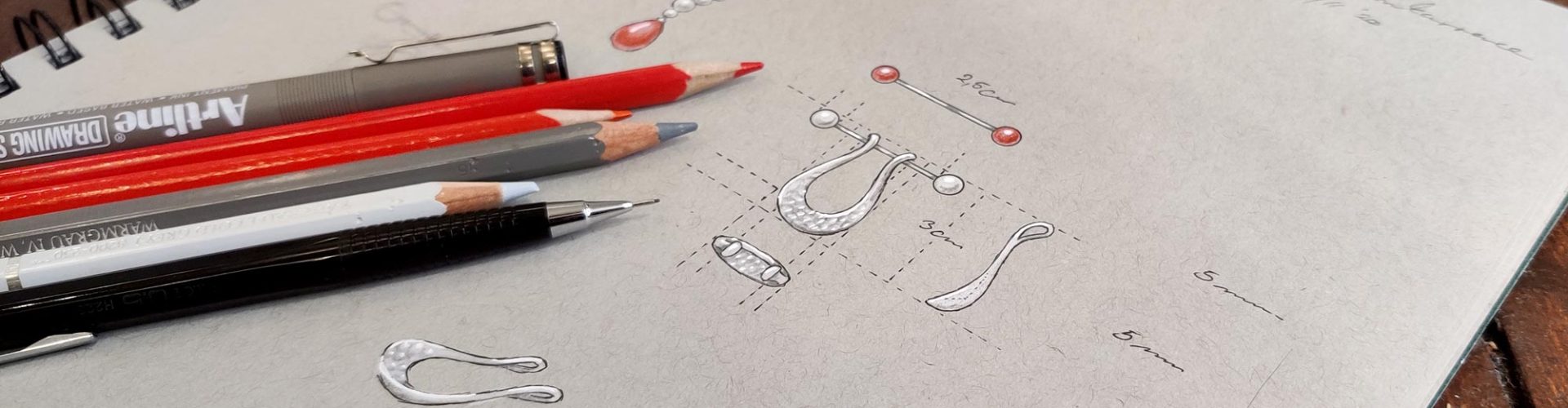
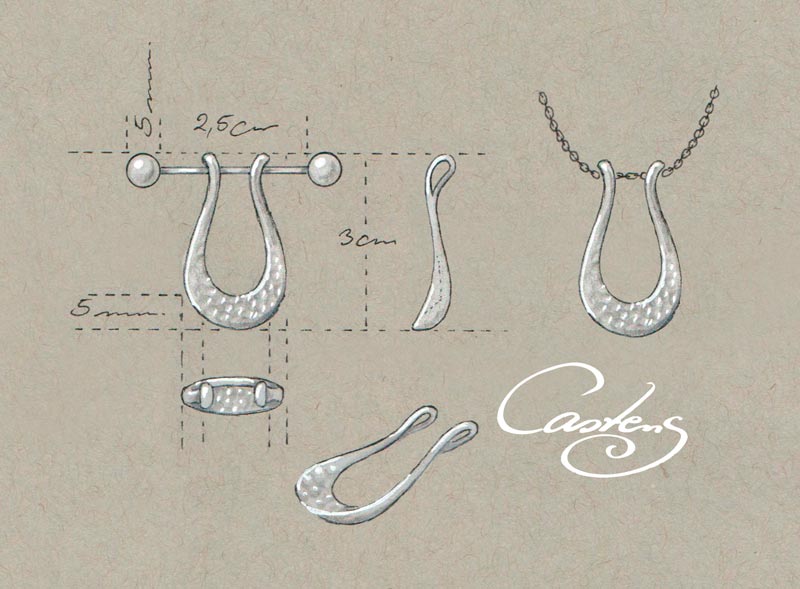
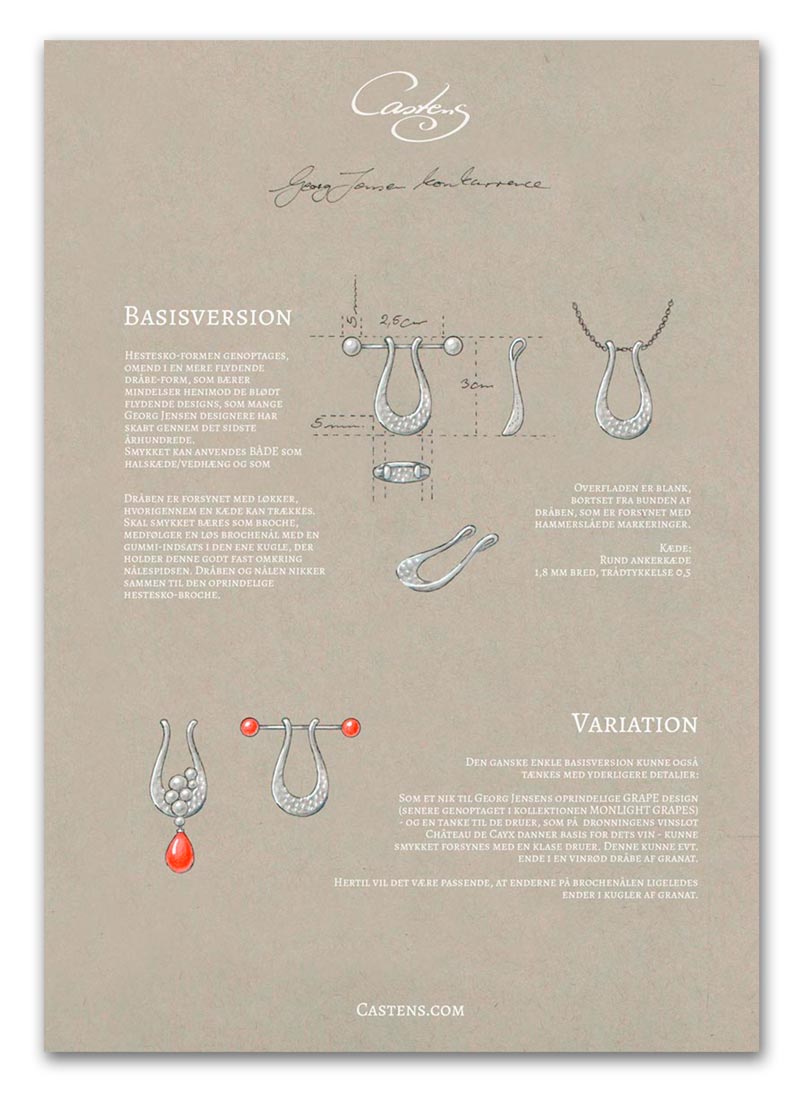
Many of the designs we associate with Georg Jensen are soft, fluid and either shiny or hammered in surface. So for me, the horseshoe shape took on a much more fluid teardrop shape, reminiscent of the jewellery that many of the house's designers have created over the last century. My jewellery could be used both as a necklace/pendant and as a brooch (which was also part of the assignment), but in a slightly alternative way:
The drop was fitted with loops through which a chain could be pulled. If the jewellery was to be worn as a brooch, a loose brooch pin was included with a rubber insert in one ball, which held it firmly around the needle tip. Together, the two elements nodded to the original horseshoe brooch. The surface was to be blank, except for the bottom of the drop, which was provided with hammered markings. Again, very true to Georg Jensen's original design language. The advantage of having a loose brooch pin instead of just placing the pin on the back of the jewellery is that it is much more comfortable to wear when worn as a pendant. It goes without saying that such a brooch pin mechanism is a bit irritating to the skin and for me it's just really important that my jewellery is comfortable to wear.
The simple basic version could also be reimagined with additional details: As a nod to Georg Jensen's original GRAPE design (later revived in the MONLIGHT GRAPES collection) - and a nod to the grapes that form the basis of the Queen's wine at Château de Cayx - the jewellery could be fitted with a cluster of grapes. This could end in a wine-red drop of garnet. It would be appropriate for the ends of the brooch pin to also end in balls of garnet.
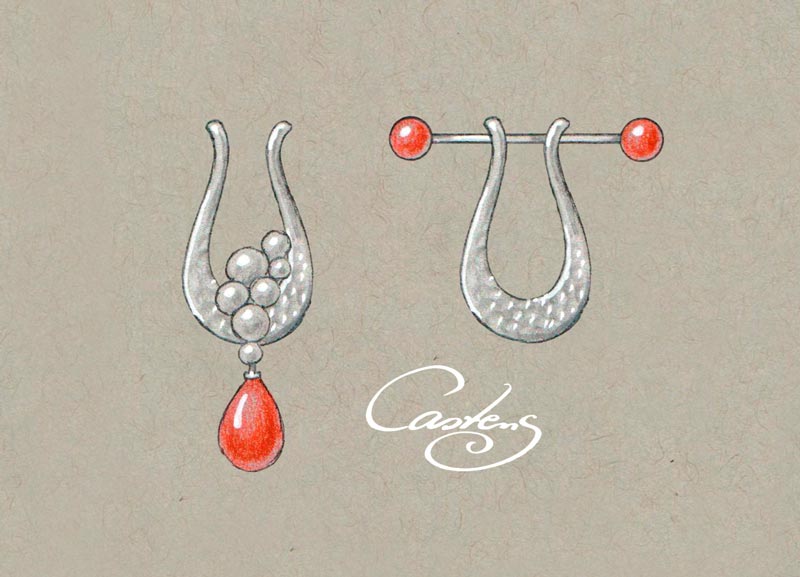
I delivered it all like this:
A fine offer, if I do say so myself! Unfortunately, I didn't win. I didn't even make it to the final, where 3 semi-finalists were announced on the Queen's birthday on 16 April and had to have their entries physically created so that the judges - and the Danes - could vote on which one should win. This was done by viewing samples of the jewellery in selected Georg Jensen stores and online until 13 June. 5 judges sat on the panel and the Danish people made up the sixth member of the panel.
Unfortunately, I have to say that I was a bit underwhelmed by the three chosen designs, which seemed relatively similar: all were roughly circular and created in an angular style.
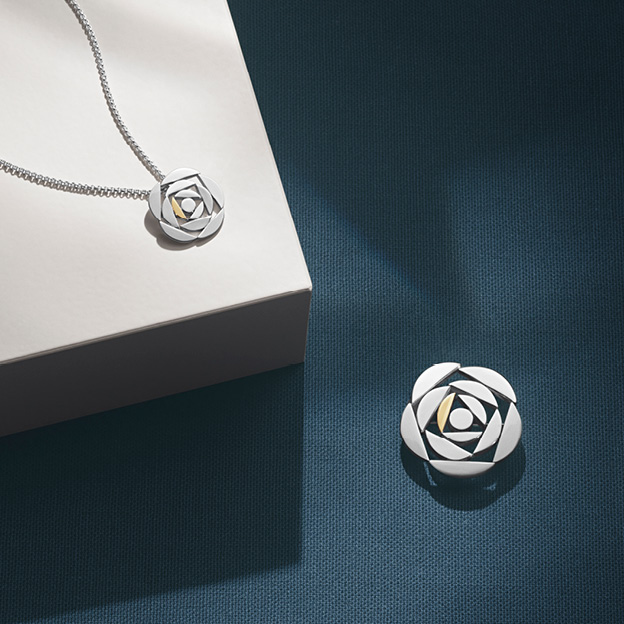
Most boring was goldsmith Ditte Stepnickas decoupage-inspired flower. A 2-dimensional thing that looks like a less dainty version of Chanel's Camellia brooch. Yes, the Queen likes to express herself in decoupage, but her work has far more depth and elegance than this naive paper cut-out. Not worthy of our queen, I think. And it's actually a bit surprising that Ditte offered this piece, because her other jewellery is far more dynamic and elegant in its striking minimalism. I recommend taking a look at Ditte's site!
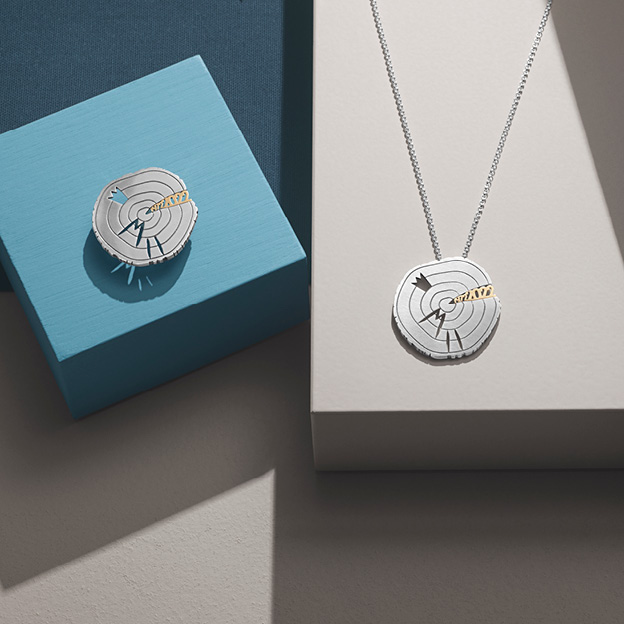
Torkil Oxe, an architect and graphic designer, came up with a brooch that... had humour? At least that's the vibe I got when I saw the image of a wooden disc with 5 year rings (one for each decade), the year 2021 wedged into a crack in the wooden disc, a stylised crown and an M II. It's fun. But I wouldn't call it pretty.
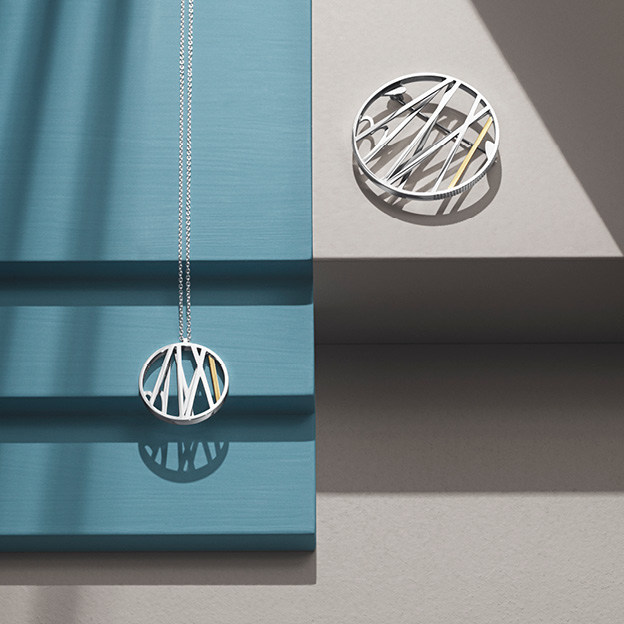
Ditte Bjerregaard and Sofie Elkjær Jensen are both architects and Sofie also works with graphics. Together they have designed a 3-dimensional piece of jewellery that, through its layered structure, nods to the scenery on a stage. Something that makes sense in relation to the times the Majesty has worked with sets and costumes. It is inspired by Her Majesty's motto ”God's help, the people's love, Denmark's strength” and the heart of the jewellery tells the story of the people's love, the golden bar symbolises God's help and the unbreakable circle that frames the jewellery represents Denmark's strength. In addition, there are 50 grooves on the frame, symbolising the reign, and the other bars represent an M for Margrethe.
The jewellery is interesting because it has multiple layers of meaning (pun intended), and unlike the other two, it has a deliberate depth that allows you to explore it. Is it beautiful? Well... it doesn't match my aesthetic, so I'm not thrilled, but it was, in my opinion, the most exciting entry among the finalists. In the end, it was actually Ditte Bjerregaard and Sofie Elkjær Jensen, whose scenography-inspired design was announced as the winner on 22 June. Congratulations - it was well deserved!
The “secret” winning criteria
All three finalists have a brooch pin on the back and an eyelet so they can be worn as a brooch or pendant. I guess. Perhaps the brief could also be interpreted in such a way that the shape of the jewellery would allow you to choose at the factory whether to have a pin on the back or an eyelet on top. It COULD be that I thought the whole thing was far more advanced than it was? Because none of the finalists had worked a bit more creatively with the brooch needle than I had, which meant that my contribution was rather alternative - at least in comparison to the finalists.
All three works relate to our queen, but I wonder why they are so strikingly similar. It seems like the selection criteria for being a finalist was ”a circular flat shape with sharply drawn edges and an overall minimalist expression”. Within THAT framework, we have three quite different entries. But that's not what was specified in the competition design brief. And to be honest, I don't think any of them managed to capture Georg Jensen's more organic aesthetic that we see in, for example Mercy, Offspring or Heritage, which is a remake or at least heavily inspired by the jewellery that Georg Jensen himself created over 100 years ago.
As I said, I don't recognise anything from the venerable company, which with this competition also wanted to celebrate their almost 120 years in business by putting the winning jewellery into production. I actually think this piece of jewellery is both exciting and well thought out. Not my personal taste, but that's why I can appreciate it on an intellectual level. It's the lack of diversity in the final field that disappoints me. The ”sixth jury member”, the Danish people, were actually given three variations on the same theme to vote on, which made the whole thing a rather dull affair. And unfortunately, I doubt it will be a hit. Maybe I'll be wrong - I hope so for Georg Jensen's sake.
My complaint is not that the rowan berries are sour. I HAVE won a gold medal in an international design competition, created wedding rings for the Prime Minister and have many happy customers who love what my particular jewellery store can offer them (and thank you for that 🙂 ). When I submitted my proposal, I didn't expect to win, even though it could be exciting. But I did expect to lose to a finalist field that I had lost to a much higher degree with some admiration.
Will you be able to get my suggestion in the jewellery shop?
And what about my design? Well... now that it didn't make it ”into the fold” at Georg Jensen, the 100% is my design and I can create it myself if I want. And also a little different, of course. For example, I think I like a milled surface more than a hammered surface. And I don't know if I want to work with the red stones, although it's obvious - maybe white pearls instead?
Time will tell if I will realise this design or perhaps work on the idea to become something completely different, while I will probably explore the brooch pin idea further. In fact, I HAVE already used this design recently when I created this pendant that my customer would love to wear as a brooch. This way, pretty much any pendant can be turned into a brooch and THAT is something! In this way, the design competition has definitely contributed to the exciting development of a design that I can use in the future.
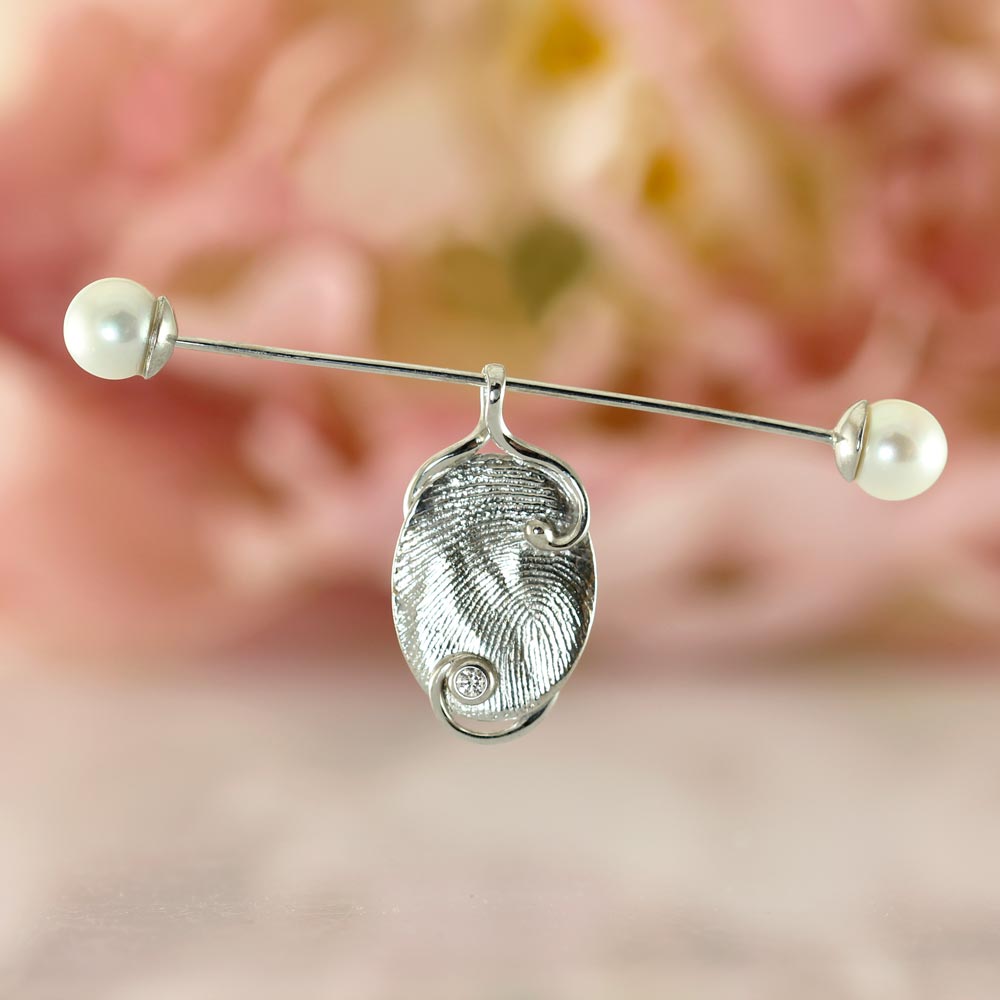
If you feel inspired to create your very own version of this design, feel free to get in touch with me.
Blog categories