



We don't know for sure when the first diamonds were found, but even before our era, stories and tales have been written about the valuable and alluring stones. One of these historical tales (Theophrastus' Book of Stones, dating back to 315 BC) even mentions the Valley of Diamonds, which Alexander the Great is said to have found during his invasion of India. The same valley is actually mentioned several times throughout history, both by the historian Pliny the Elder (in the 1st century), in the Arabian Nights (around 850), and in Marco Polo's travelogues (1298).
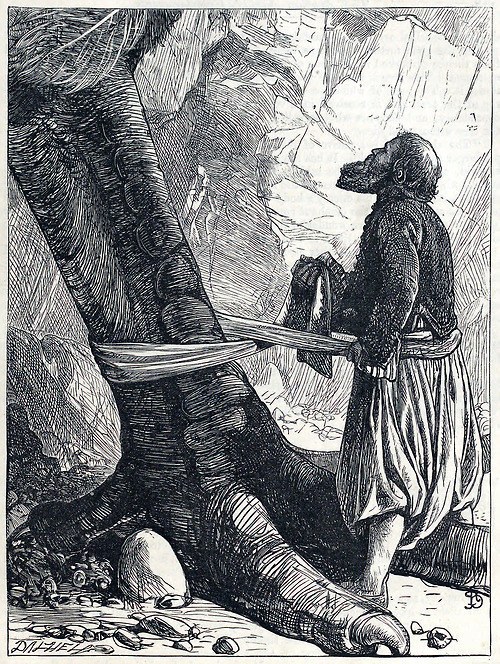
Woodblock print from the legend of Sinbad the Navigator in the Valley of Diamonds, as described in The Arabian Nights.
But it wasn't until Vasco da Gama found the sea route to India around 1497-99 that Europeans really got to see real diamonds with their own eyes. Until then, it was mostly fatamogana talk and nursing stories. But the riches of the Indian soil are really getting things moving! The strange thing is that when we look at our marriage and wedding traditions today, they often have a religious origin. But there is no mention of diamonds or diamond rings in the Bible, so the leap from the Valley of Diamonds to the woman's ring finger must be found elsewhere. And to understand how the diamond has become such an important part of our jewellery tradition, especially when it comes to engagement and wedding rings, you need to understand why we have these symbols of connection in the first place.
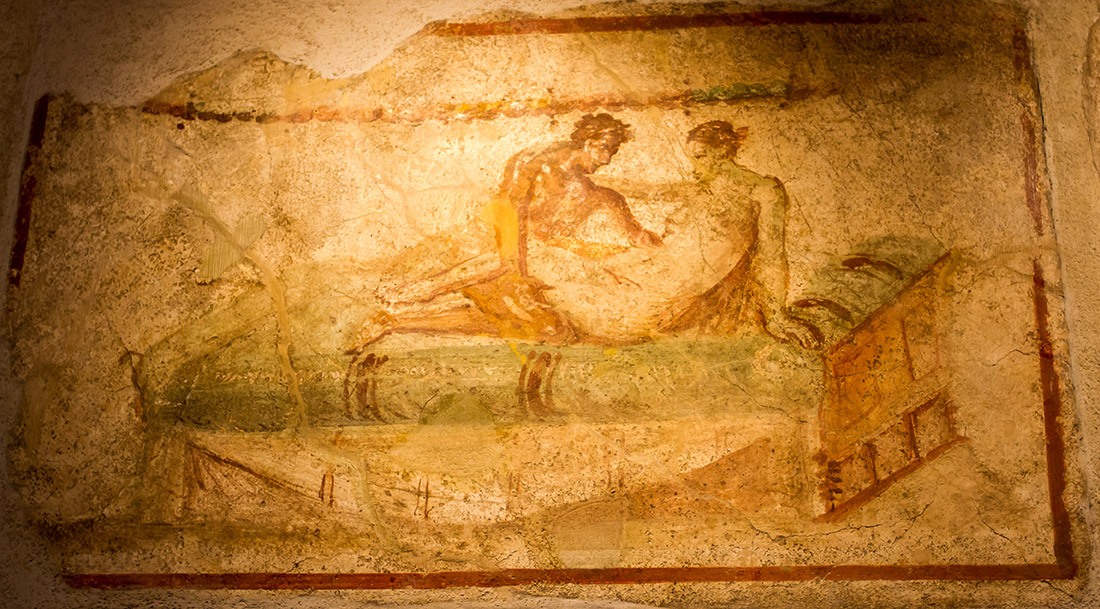
We find wedding rings as far back as the ancient Roman Empire, several centuries before our time. However, legend has it that long before Roman civilisation was born, there were rituals that symbolically bound a woman and a man together. Back when humans still lived in caves, it is said that men would tie ribbons of woven grass around the waist, ankle and wrist of their women. This was done in the belief that the man could bind the woman's soul so that she never looked to another man's side.
And if you think about it, this kind of security measure has actually characterised most of the history of wedding and engagement rings ever since. In Roman times, a woman had to wear a gold ring in public, signalling that she belonged to a man and was therefore his property. At home, however, she simply wore an iron ring as it was cheaper, more durable and better able to withstand the wear and tear of domestic labour - you're practical... 😉 😉
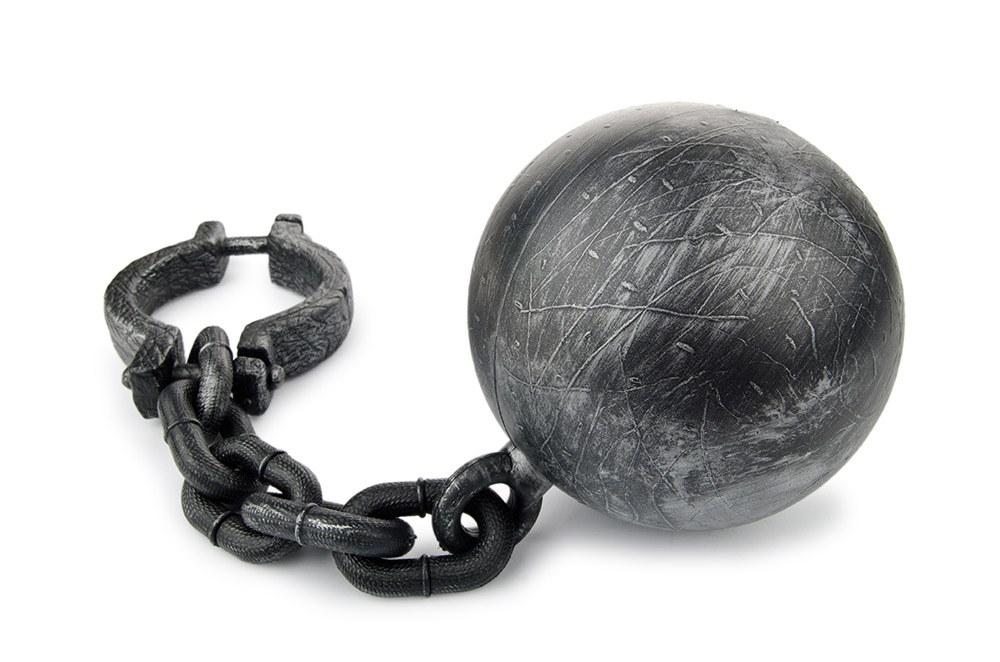
From Cupid's arrow to the banks of the Orange River
Until about 150 years ago, diamonds were infinitely rare and no ordinary person could hope to come close to owning a diamond ring. The precious stones were reserved for the gods, royalty and nobility. So to find the fabled connection between love and diamonds that we know today, it is precisely in these circles that we must now move. A little curiosity: Besides being beautiful, diamonds are also extremely sharp and are therefore used on the best scalpels in the medical industry. And where did they get this brilliant idea? From the god of love, Cupid, of course!
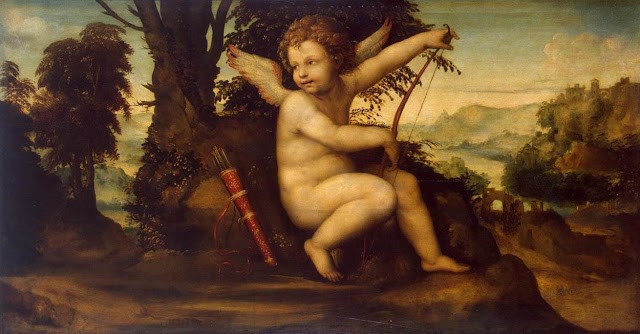
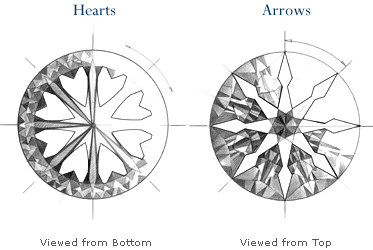
It is said that Cupid dipped his arrowheads in diamonds to better pierce the human heart. But Cupid's influence on diamonds today doesn't end there. If you do a bit of jewellery shopping, you will undoubtedly come across the famous “hearts and arrows” diamonds. Inspired by Cupid and his “work”, a very special cut has been created that produces a play of 8 hearts and 8 arrows in the diamond's lines. This cut is the most perfect cut and therefore has the highest brilliance. Something to keep in mind if you're thinking of taking a knee in the near future...
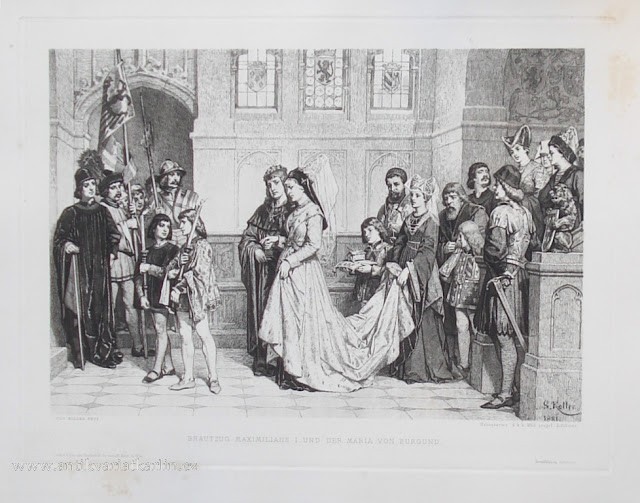
But now we're getting ahead of ourselves! Let's go back to history and get the nobles involved. The first place in history where we come across a recorded historical account that includes a diamond engagement ring is the engagement of Maximillian of Austria and Maria Burgundy on 16 August 1477. These two people simply became trendsetters for European nobility, and THEN the demand for the sparkling “grit” increased. Unfortunately, at that time, there were only a few known occurrences of diamonds in the world (India), and they were mostly just more or less random finds. The rarity that surrounded diamonds back then may be hard to comprehend today, but for that very reason, other engagement trends also gained ground and are still going strong today.
We're talking about Claddagh rings, of course. No...? Never heard of them? If you have Irish or American friends, ask them if they know about the phenomenon. They'll probably say yes. The Claddagh ring was originally created as an engagement and wedding ring, with the hands symbolising friendship, the crown loyalty and the heart of course love. There didn't have to be a diamond, other stones could be used, and for most people the entire ring was just gold.

Claddagh ring in a Castens version: A combination of silver and gold with an aquamarine heart and a small diamond
The idea of two hands reaching out towards each other on a ring, symbolising a bond of some kind, is actually an old one. These rings are called ”fat rings”, not because they were particularly powerful in the estate, but because the term comes from the Italian ”Mani Fede” (hands loyally linked). This usage can be traced back to the ancient Roman Empire, where shaking hands was a symbol of making a promise (just as it still is in Jutland today). In the Middle Ages and Renaissance, these rings were often used as wedding rings.
The Claddagh ring became really popular in Ireland in the 1800s and, as mentioned, is still very popular, even among the descendants of Irish immigrants in the US who proudly wear it as a symbol of their Irish roots. As an example of this (with a slight chuckle thrown in), it is said that when the ruins of the Twin Towers in New York were searched after the horrific terrorist attack on 11 September 2001, no less than 200 Claddagh rings were found!

But diamonds had once and for all established their status as the ultimate expression of love for those who can. But it takes one young man's search for pretty stones for the world to truly unlock Mother Earth's diamond treasures. Erasmus Jacobs is 15 years old and lives in the Hopetown district along the Orange River. While looking for nice stones for his sister one day, he finds a beautiful yellow stone, and although many other diamond discoveries have been made by locals in South Africa, this still stands as the first official diamond find. The stone, better known as Heureka, still exists to this day. In the Diamond Museum in Kimberly, South Africa, you can see a replica - the original is located in Harry Oppenheimer House - the building where De Beers sorts the rough diamonds. The Kimberly mine, which resulted from Erasmus’ discovery, became one of the world's first and most profitable diamond mines.
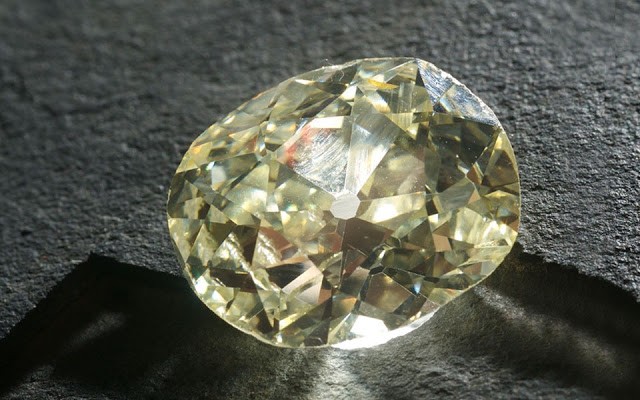
The Eureka diamond as it looks today. The cut is so-called “antique cut” - the old-fashioned way of cutting with slightly fewer facets and where the tip of the diamond is cut off (seen as a small circle in the centre of the diamond). Due to its history, the stone is virtually priceless and will therefore hardly ever be recut.
Love stones? More like cold cynicism
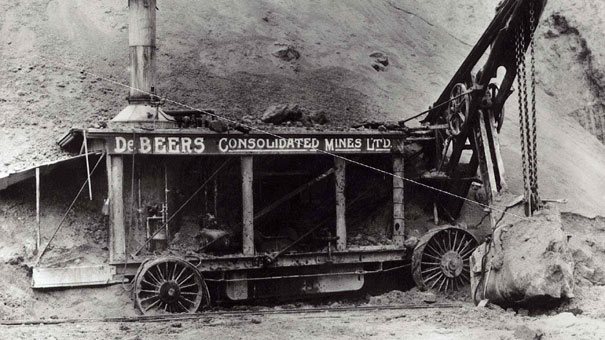
Over the course of a few years, more large diamond fields appear and suddenly diamonds are available, even for people with non-royal budgets. Or... Well... You might know a little about the price of diamonds yourself, and you certainly know that they're not cheap. So why is it that when you think of marriage and engagement, you probably also think of a diamond ring? The explanation can be found in one place: De Beers Consolidated Mines, Ltd. or The Diamond Company, as it is also known. Despite all the traditions, legends and historical facts we've already covered, the fact is that before De Beers came along, there was no real tradition of diamond engagement rings. So how did a company manage to create such a worldwide tradition? Let's take a closer look at De Beers.
It would be natural to think that the founder(s) of De Beers were also called De Beers. But the name actually comes from the two brothers who probably missed out on the biggest profit in history, Johannes and Diederik De Beers. After a somewhat unsuccessful diamond adventure, they sold a large part of their South African land to the 18-year-old Englishman, Cecil Rohdes, and it was he who, in just a few years, created the world's leading diamond and mining company, De Beers.
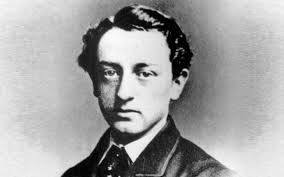
A young Cecil Rohdes at just 18 years old
Within the first year, Cecil finds both the De Beers mine and the Kimberly mine on the purchased plots of land, both of which turn out to be among the largest diamond mines in the world. One can only imagine the exasperation of the two De Beers brothers... It may be a little strange to think about but, Cecil Rohdes, a man whose name you may not have heard before, is the main reason why we associate diamonds with exclusivity, love and engagement to this day.

Cecil in his glory days
Cecil himself was certainly not a romantic or nice man. He never married and had no children. Today, there is speculation that he may have had a secret love life with one or more of his male employees. But at the time, it seemed that the only things that filled Cecil's heart were diamonds, power and money. And he got all three in abundance. He was adamant that diamonds should be an absolute luxury item and coveted like a drug.
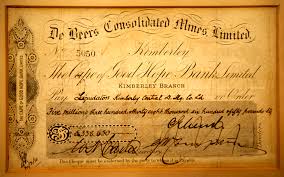
Through brutal acquisitions, following the motto “Any man can be bought with money”, Cecil managed to secure all mining operations in South Africa in 1888. His two original mines alone now employed over 50,000 people. De Beers Consolidated Mines, Ltd. was born. The violent and often ruthless pursuit of diamonds and new mines certainly didn't make Cecil popular. But he was coldly indifferent to the end and died alone, aged 49, as one of the richest private individuals of the 19th century. He passed the torch to Ernest Oppenheim, whose family continued to run De Beers in the same spirit for many years to come.
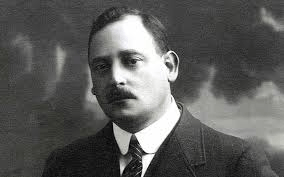
At this time - in the 1900s-1930s - De Beers was sitting on 95% of the world's diamond mines, and it's safe to say they had a luxury problem. From the South African underground, so many diamonds were being extracted that the prices of the precious stones were plummeting. It had to be stopped! But what could they do? They already controlled the world's supply of diamonds. The answer lay at the end of the long journey from the mines in South Africa, to the jewellers and goldsmiths in the world's biggest cities, to the people who ultimately pay for these stones. De Beers failed to control demand.
With the same simple determination and cynicism of Cecil Rohde's time, they set about devising one of the most ingenious and comprehensive marketing campaigns of the 20th century, the campaign to connect true love with the stone of eternity, diamonds. And the wildest part is: No one realised it was a marketing ploy...
Depression, diamonds and Santas
We are in the time between the two world wars and right in the middle of the Great Depression. Unemployment is huge, food is scarce and there is absolutely no extravagant gestures. The last thing on people's minds is buying expensive diamond jewellery and rings. The global company De Beers, which over the past 70 years has brutally acquired something of a monopoly on mining the world's diamonds, has a problem. They currently dig several tonnes of diamonds out of the ground every year in Africa, but demand is declining rapidly.
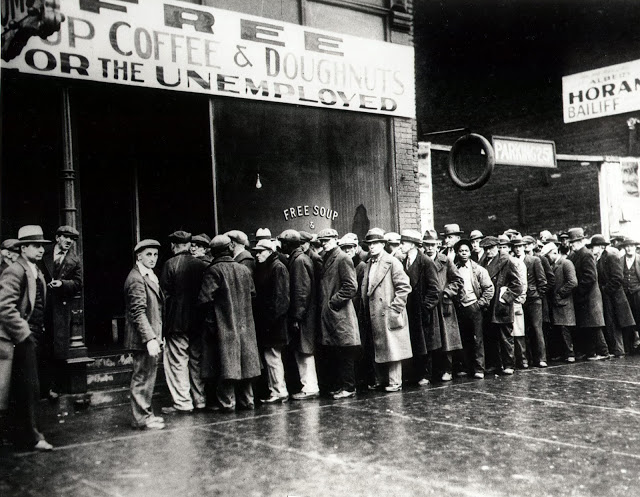
Some jewellers had tried to start a trend for men's engagement rings in the 1920s - that idea died very quickly and it was back to the drawing board. In the late 1930s, the typical diamond purchased in an engagement ring was small and of very poor quality, with an average price of 80$ (about 1.000$ today). These days, De Beers is actually closing several of its mines and reportedly stockpiling tonnes of diamonds in an attempt to keep the price up just a little, but without much success. Harry Oppenheimer, who now heads De Beers, knows that something has to be done. One of the challenges was explaining the value of one quality of diamond over another. The division that the company itself uses to classify diamonds consists of 12 - 14,000 categories. It's ALL too confusing and confusing. So in 1939, the GIA, the world's largest and most renowned gemological institute, launched the famous 4 Cs: Carat, Cut, Clarity, Colour.
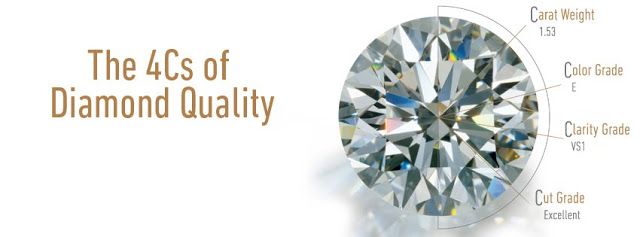
The four concepts are designed to make it easy for customers to feel like “experts” in diamonds, creating an easily accessible snob effect where it's not just about buying any diamond, but about buying a diamond that ranks high on the scale within each of the 4 Cs. The public fully embraced the idea and the 4 Cs spread like wildfire in the jewellery industry. To this day, they are still the “units of measure” by which a diamond is judged, and even young women know the difference between a river and a pique diamond (if you don't, fear not. You can find a crash course on the 4 Cs of diamonds here)
However, this is still not enough to create any significant demand and willingness to buy among the war-torn population. De Beers therefore approached a large advertising agency in Philadelphia and asked them to create a propaganda campaign - yes, that's what they called it at the time - that could “create a situation where almost every person who wants to take the vows feels obliged to buy a diamond engagement ring”. N.W. Ayer, as the agency was called, set about the task, launching what must be one of the world's first product-placement campaigns.

In a major collaboration with Hollywood film companies, diamond engagement rings are now starting to appear on film. De Beers supplies the jewellery and the film companies dress their beautiful starlets in lots of diamonds, both for premieres and on screen. The jewellery is bought in gossip magazines and engagement sessions are arranged with famous stars, where the gentleman gives his beloved a diamond ring. But it doesn't stop there, De Beers also paid for what they called “educational visits”, visiting various high schools to indoctrinate young people into the belief that a diamond engagement ring was the “traditional” and only true way to declare your love.

The crowning glory was created by N.W Ayer in 1947 when Frances Gerety wrote the slogan “A Diamond is Forever”. She created the campaigns for De Beers for almost 25 years. This tagline has followed De Beers ever since and has been voted the best slogan of the 20th century. The phrase has been used in songs, on film, in art and in all of De Beers’ campaigns. But most importantly for De Beers: it worked.
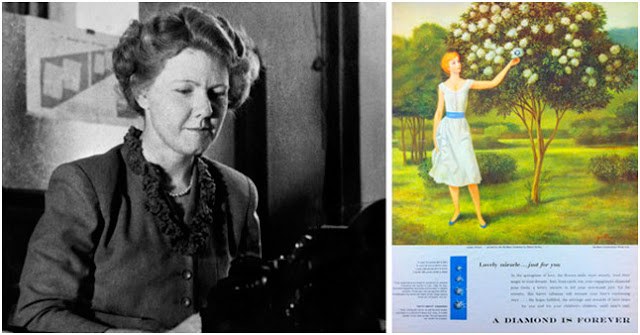
But in the summer of 2016, De Beers launched a new slogan and campaign to reach the new target group - The Millenials: ”Real is Rare. Real is a diamond”. Say what you will about the slogan, but it is clear that it is a different target group with different values that the company is trying to appeal to. Whether it works remains to be seen.
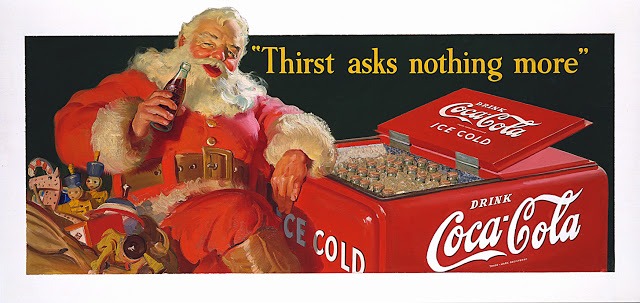
But back to the historical facts: at the end of World War II, there were diamonds in approximately 10% of all engagement rings. By the end of 2000, that number had risen to almost 80%! The impact that the De Beers campaign has had on our engagement tradition is second only to the impact that Coca Cola's campaign from the same period has had on Christmas. Because just like diamond engagement rings, it certainly hasn't been a tradition that Santa was a big smiling, white-bearded man dressed in red. In fact, this - now worldwide - tradition was first established with Coca Cola's 1931 Christmas campaign. And just as Coca Cola dressed Santa in his good humour and his red suit, so De Beers made love and the diamond inextricably linked.
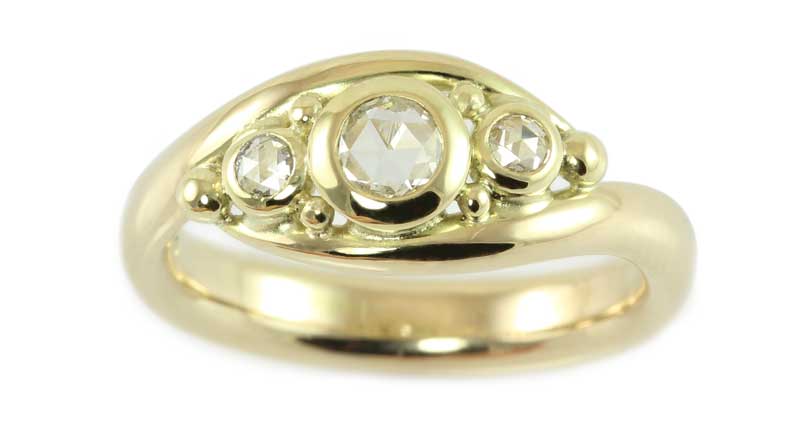
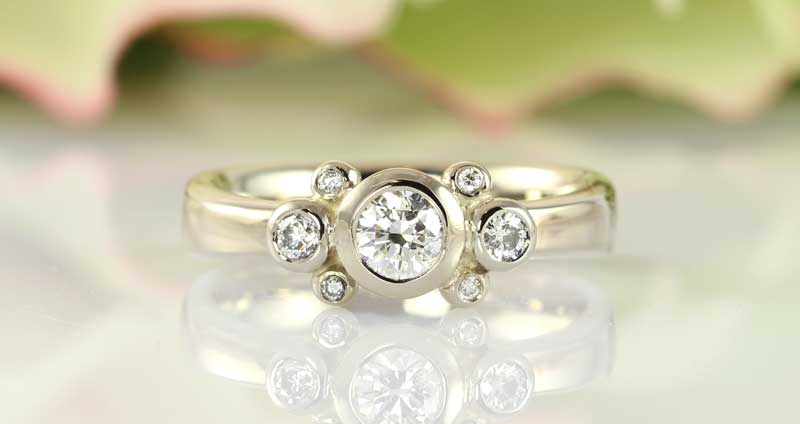
When we at Castens create both engagement and wedding rings, we draw on all the traditions on which this story is based. And for us, there is no single truth about what can symbolise love between two people. A particular shape, surface or motif can be just as meaningful as a particular gemstone - such as the marvellous diamond.
The story of how de Beers has seduced the world into favouring diamonds when declaring true love doesn't change the fact that a diamond, with its durability and beauty, is the perfect symbol of lasting love. While the jewellery we create may be just the spice of life, there is nothing better than seeing the light in a man's eyes when he picks up the diamond ring that symbolises for him the desire for a brilliant future with his one and only.
Read an interesting article with a lot of thought-provoking statistics about Who, where and how we want to ask the big question
Blog categories